Do acquisition targets with a high share of recurring revenue actually produce better financial returns?
In entrepreneurship through acquisition and search funds, recurring revenue (RR) has long been treated as a gold standard. Stable cash flow, predictable sales and lower operating risk make it attractive to investors and acquisition entrepreneurs. A recent Yale School of Management study challenges that consensus.
The Yale study: high RR does not necessarily mean high returns
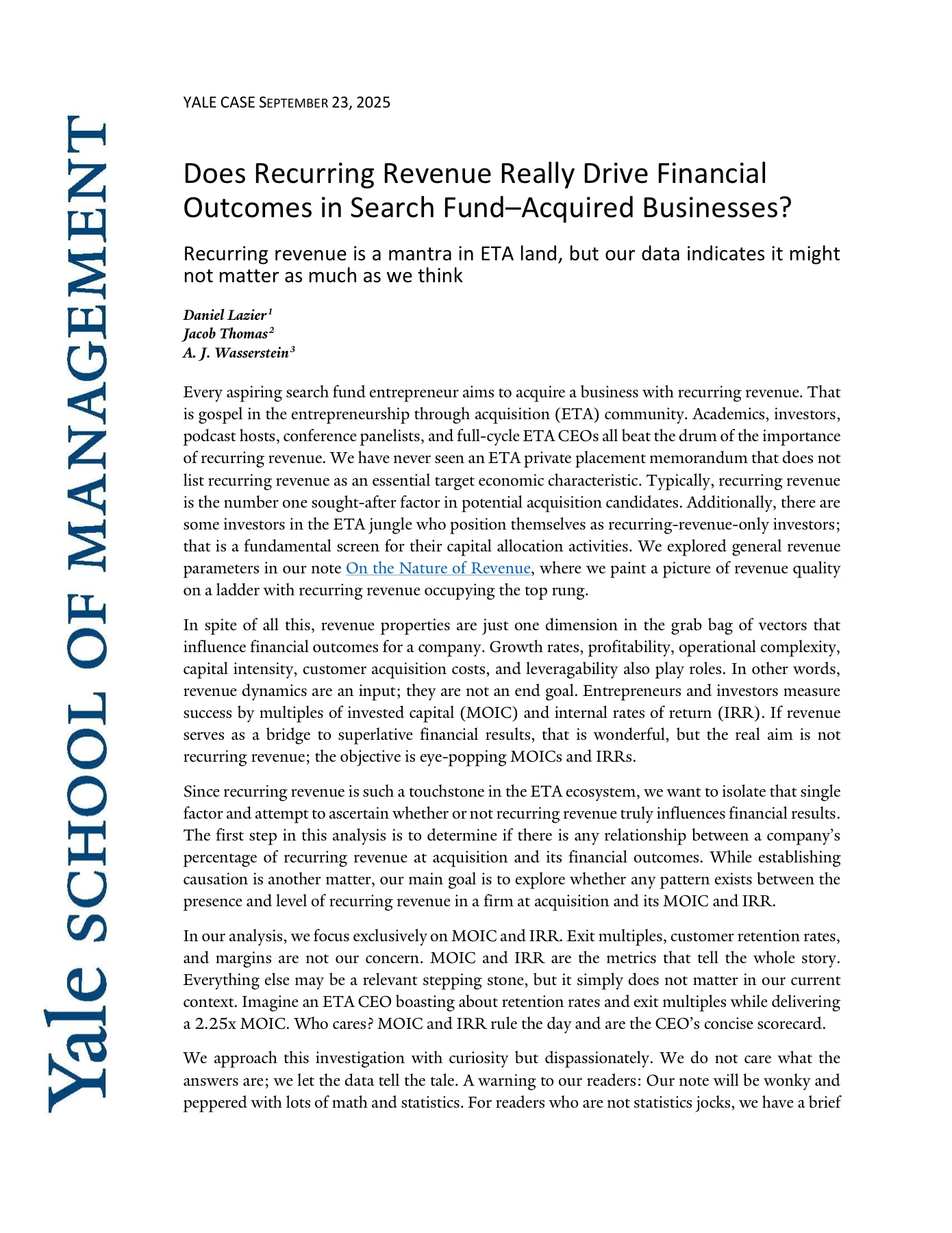
A. J. Wasserstein, Jacob Thomas and Daniel Lazier analysed 59 search fund acquisitions that had subsequently exited. They recorded each company’s recurring revenue percentage at acquisition, ranging from 0% to 100%, and grouped the companies into four broad categories: none, low, moderate and high recurring revenue.
They then compared those percentages with the companies’ eventual multiple on invested capital (MOIC) and internal rate of return (IRR). The study found no statistically significant relationship between recurring revenue at acquisition and either measure of return. In other words, companies with more recurring revenue did not necessarily produce higher MOIC or IRR.
The only statistically significant relationship appeared in the purchase price: companies with more recurring revenue were acquired at higher EBITDA multiples. The market was willing to pay more for predictability, but that premium did not translate into better returns in this sample.
The researchers nevertheless identified three practical benefits of recurring revenue:
- it gives a first-time CEO more breathing room and reduces near-term cash flow pressure;
- it makes an acquisition more attractive to investors and easier to finance; and
- increasing recurring revenue during the holding period may support a higher valuation from the next buyer.
The study therefore challenges the idea that recurring revenue alone should determine whether a company is an attractive acquisition target.
What the debate added: the directional signal may still matter
The study prompted discussion among search fund investors and acquisition entrepreneurs. Much of the debate focused on sample size. Fifty-nine completed acquisitions is meaningful in the search fund market, but it remains a small statistical sample. Once the companies are divided into recurring-revenue groups, some groups contain only a handful of observations.
One interpretation was that, if the same distribution were maintained and the sample expanded to about 177 companies, the relationship between recurring revenue and returns might reach statistical significance at p<0.05.
The discussion also considered two hypothetical investors: one holding 30 low-recurring-revenue companies and the other holding 30 high-recurring-revenue companies. Across thousands of simulations, the two portfolios still overlapped substantially. The high-recurring-revenue portfolio nevertheless had a lower probability of complete failure and a greater chance of producing an outsized return.
The broader point was not that recurring revenue should become the objective. What matters is the quality behind the number: customer retention, repeat purchasing, competitive protection and how essential the product or service is to customers. The recurring revenue percentage is only a simplified proxy for those characteristics.
A broader view: the limits of a single metric
Goodhart’s Law holds that when a measure becomes a target, it often becomes less useful as a measure. Recurring revenue began as a way to assess revenue stability. Once the market turned it into a required feature of a “good business,” its usefulness as a screening metric began to weaken.
Business quality depends on the structure behind the number. A high recurring revenue percentage does not necessarily mean strong customer loyalty, durable contracts or essential demand. If growth depends on one major customer, discounted renewals or external subsidies, the headline percentage may say little about the durability of future cash flow.
The market’s preference for recurring revenue also reflects a collective willingness to pay for certainty. Venture capital often pays for the possibility of rapid change; acquisition investors may pay a premium for stability. In both cases, a desirable characteristic can become overpriced.
In China and other emerging markets, stable revenue may come from distribution relationships, licences, geographic protection or long-standing supply arrangements rather than subscriptions. The better question is therefore not simply how much revenue recurs, but what makes that revenue resilient.
Sources
- Daniel Lazier, Jacob Thomas and A. J. Wasserstein, Yale School of Management, Does Recurring Revenue Really Drive Financial Outcomes in Search Fund–Acquired Businesses?, 2025.